
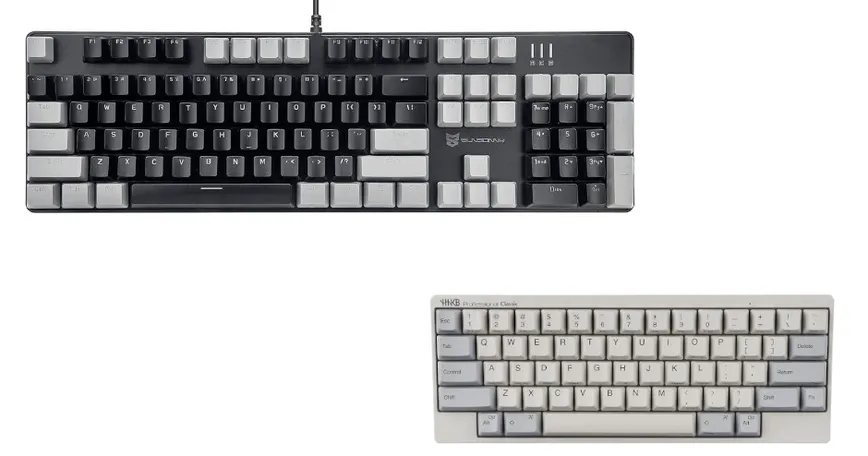
What Are the Differences Between High-End Mechanical Keyboards and Cheap Mechanical Keyboards?
Even though they are all called mechanical keyboards, they range widely from high-end models costing tens of thousands of yen to budget models available for just a few thousand yen. We've summarized the differences between high-end and budget models, what makes high-end keyboards better, and what makes cheap ones worse.
Modified at: 2025.7.14Posted at: 2022.9.8
Table Of Contents
Main Differences Between High-End and Cheap Mechanical Keyboards
Differences in Key Switches
One of the biggest differences between high-end and cheap mechanical keyboards lies in the mechanical key switches. This is because the most expensive part of a mechanical keyboard is the key switch.
Mechanical keyboards that retail for over $100 generally use Cherry MX switches or proprietary mechanical switches.
Cherry MX switches are not only excellent in typing feel but also offer top-tier durability and quality, costing over $1 per switch when purchased individually. This means that a full-size keyboard with 108 keys would cost over $100 just for the switches.
On the other hand, cheap mechanical keyboards often use switches made by Chinese manufacturers, commonly referred to as “Chinese switches.” While the quality of Chinese switches has been improving year by year, they still fall short of high-end switches like Cherry MX in terms of durability.
Chinese switches can be purchased for around $1 per unit even for general consumers. This means that a mechanical keyboard can be made at about half the cost of one using Cherry MX switches, just in terms of the switches.
Differences in Keycap Quality
There are also differences in keycap quality between high-end and cheap mechanical keyboards. The main differences in keycaps are the “material of the keycap” and the “printing method of the legends.”
High-end mechanical keyboards pay attention to the tactile feel of the keycaps that your fingers touch and use materials that are resistant to dirt. On the other hand, the keycaps of cheap mechanical keyboards are often the same as those found on budget keyboards priced around $20.
Differences in printing affect whether the legends fade over time and whether they are clearly visible when illuminated by backlighting.
Differences in Connection Methods
In mechanical keyboards, the connection method surprisingly has a significant impact on the price. Especially, mechanical keyboards that support Bluetooth or wireless connections tend to be more expensive.
For wireless connections, since the keyboard cannot be powered directly, it needs to have a built-in battery. Additionally, chips for wireless connectivity and battery management are also required.
Although it may sound simple to say “wireless connection,” various internal components are needed, which drives up the price.
Differences in Accessories
For ultra high-end mechanical keyboards priced over $200, differences also appear in the included accessories.
Depending on the model, accessories may include a carrying case for transporting the keyboard, a cleaning cloth, or a high-quality wrist rest designed to match the keyboard.
While some may think, “I don’t need accessories, just make it cheaper,” manufacturers likely include them out of a desire for users to take good care of their high-end products.
Are High-End Mechanical Keyboards "Actually Not That Expensive"?
As we've seen so far, there are clear reasons why high-end mechanical keyboards are more expensive.
When considering purchasing a high-end mechanical keyboard, you may wonder, “Is it really worth this price?” However, keyboards equipped with premium switches like Cherry MX actually offer good cost performance when considering durability.
For example, if you can use a $300 mechanical keyboard for 10 years, that’s $30 per year. While people don’t usually replace keyboards every year, even if you replace it every three years, that’s about $100 per keyboard.
A $100 keyboard is fairly expensive, but if you keep buying mid-range keyboards around that price in search of something better, you could end up spending enough to buy a $300 high-end keyboard after just a few tries.
One of the advantages of high-end mechanical keyboards is their durability, so in reality, the difference may just be whether you buy cheap ones multiple times or invest in a high-end one once.
Cheap Mechanical Keyboards Are Ideal for "Trying It Out"
That said, jumping straight into a keyboard costing several hundred dollars can be daunting, especially if it’s your first time switching keyboards or trying out a gaming keyboard.
Mechanical keyboards vary in feel depending on the type of switch, so finding the one that suits you can take time (and replacement costs).
For such users, cheap mechanical keyboards are the perfect option.
Cheap mechanical keyboards can be purchased for around $30, and even those with decent quality are available for around $50.
It’s a good idea to first try out mechanical keyboards and different switch types with a cheap model to see what suits you best, and then consider buying a high-end mechanical keyboard.